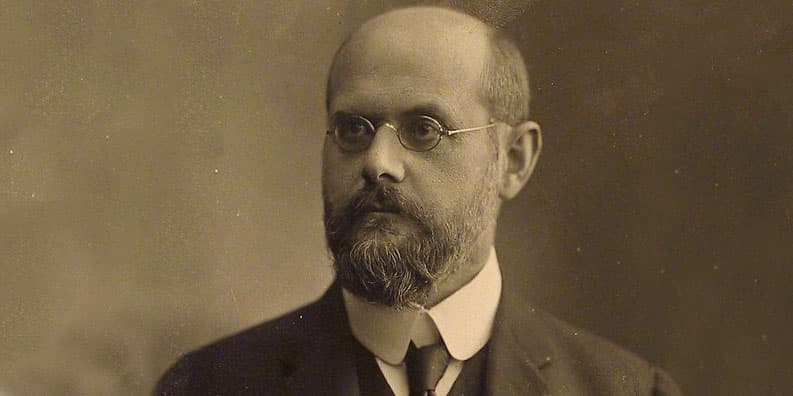
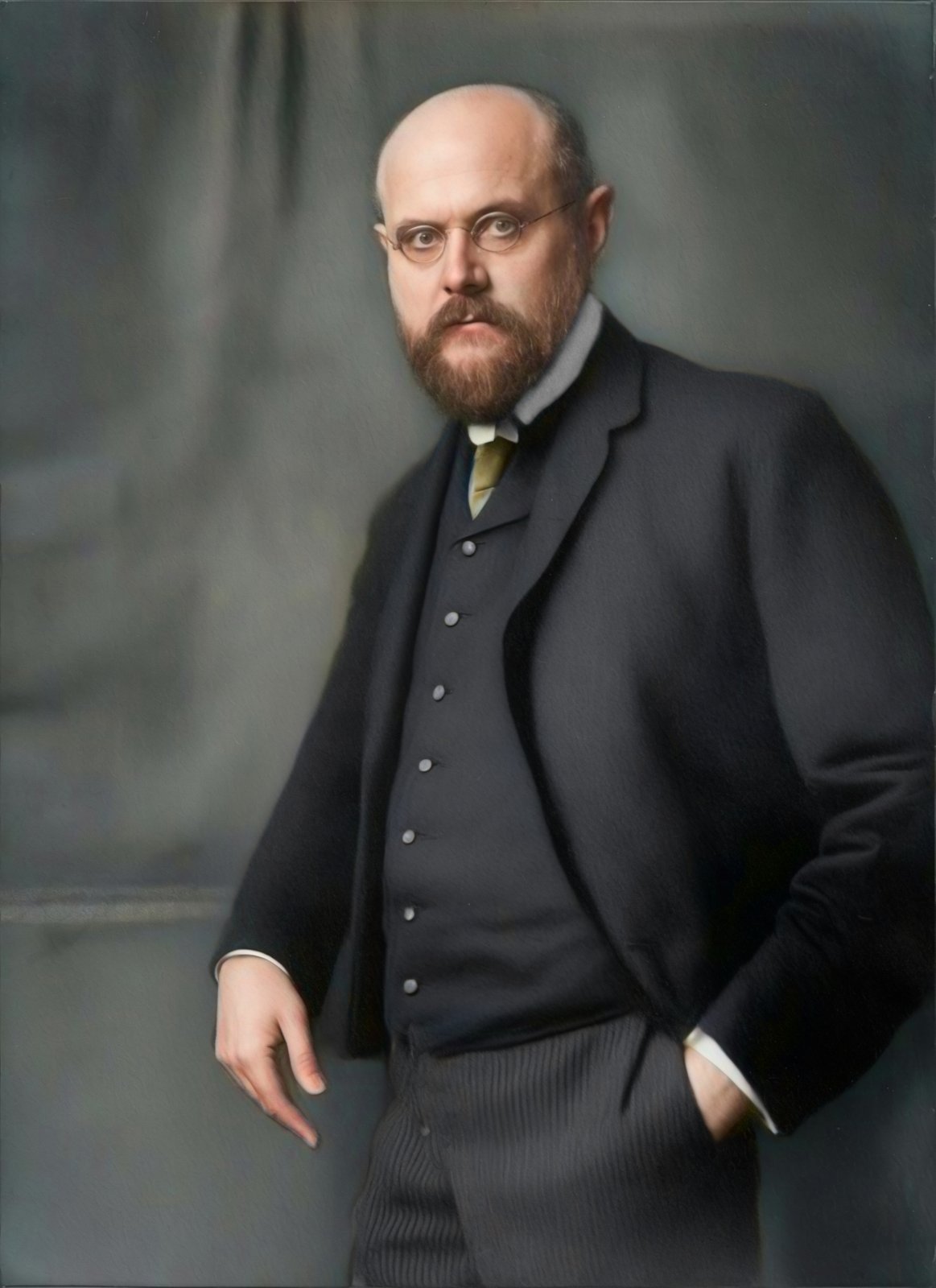
FOLIO I · DENKER

Born on 15 March 1858 in Vienna, the descendant of an Austro-Bosnian family of officers; he grew up half-orphaned.[1]
Completed the Theresianum and his law studies in Vienna.
Habilitation in political economy at the University of Vienna with a study of the Bank of England (following periods of study in Berlin and London).[1]
Associate and later full professorship at the University of Freiburg; in matters of value theory and methodology he followed Menger closely there.[1]
Full professor of economics and public finance at the University of Freiburg.[1]
Publication of the highly successful textbook "Grundriß der Politischen Ökonomie" (Outline of Political Economy), with which Philippovich effectively promoted the Austrian School.
Dean of the Faculty of Law and Political Science at the University of Vienna.[1]
As a member of the Viennese Fabian Society, co-founder of the Social Policy Party in 1896; for one legislative term a deputy in the Lower Austrian Landtag (provincial diet).
From 1904 to 1917, co-editor of the "Zeitschrift für Volkswirtschaft, Socialpolitik und Verwaltung" (Journal for Economics, Social Policy and Administration); for many years chairman of the Gesellschaft der Österreichischen Volkswirthe (Society of Austrian Economists).
Philippovich gehörte im Verein für Socialpolitik dem „Wiener Flügel“ an, der gegenüber Schmollers preußisch-historischer Linie eine theoretisch fundierte Sozialpolitik vertrat; 1908 wurde Schmoller eine Festschrift gewidmet, an der auch Philippovich beteiligt war – die Antipoden-Beziehung war damit zugleich Verhandlungsbeziehung.[1]
Turned to economics during his studies in Vienna under the influence of Eugen Philippovich von Philippsberg; alongside Wieser and Böhm-Bawerk, Philippovich belonged to the circle of formative Menger students at the University of Vienna.[2]
Somary was Philippovich's assistant at the University of Vienna in 1904-1906; Philippovich later arranged for him the post of assistant to the president at the Anglo-Österreichische Bank.
Philippovich war 1913 als Lehrstuhlinhaber für Politische Ökonomie der formelle Habilitationsbetreuer Mises' an der Universität Wien (Aufgabenhinweis aus Pipeline-Briefing).
Emil Lederer studied economic theory at the University of Vienna, among others under Philippovich, Wieser and Böhm-Bawerk.[6]
Max Weber succeeded Philippovich to the chair in Freiburg im Breisgau in 1894.[3]
Eugen Philippovich von Philippsberg in the context of the School as a whole: five generations, their teacher-student lineages, circles and collegial ties.
Show in the family tree →