FOLIO I · THINKER · GEN. 04 · N° 011

Paul Narcyz Rosenstein-Rodan

Works
9
Articles
4
Generation
4.
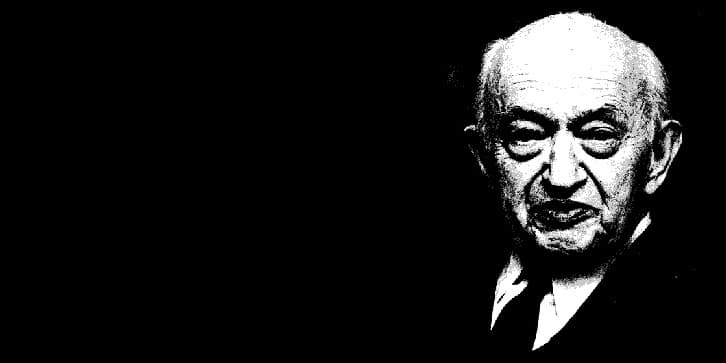
Portrait of Paul Narcyz Rosenstein-Rodan
FOL. 04 · N° 011 · Paul Narcyz Rosenstein-Rodan
BIOGRAPHY

Life and Work

Paul Narcyz Rosenstein-Rodan came from a Jewish family in Cracow. He took his doctorate in law in Vienna and became an assistant to Hans Mayer. On racial grounds and on grounds of faculty politics, however, he was denied his habilitation. At the age of 25 he wrote, for the fourth edition of the Handwörterbuch der Staatswissenschaften (Concise Dictionary of the Political Sciences), the much-noted article on the concept of marginal utility (1927), followed by an equally prominent contribution on the role of time in the economy (1929). By showing that the economic notion of an 'equilibrium' does not, as a rule, give adequate weight to the role of time, he set off an international debate. In 1931 Rosenstein-Rodan received a teaching post at University College London, went on to establish himself as a highly regarded specialist on developing countries, and latterly belonged to the Massachusetts Institute of Technology (MIT).
Metadata
1. Januar 1902
in Krakau
28. April 1985
Generation 4
Life stations

Stations

  1. 1902
    1902
    Birth

    Born in 1902 in Kraków, into a Jewish family.

  2. 1925
    1925
    Doctorate in Law

    Earned his doctorate in law in Vienna and became an assistant to Hans Mayer. For racial reasons and reasons of faculty politics, he was not granted a Habilitation.

  3. 1927
    1927
    Article on marginal utility

    At the age of twenty-five he wrote, for the fourth edition of the Handwörterbuch der Staatswissenschaften, the much-noted article on the concept of marginal utility.

  4. 1929
    1929
    Contribution on the role of time in the economy

    There followed an equally prominent contribution on the role of time in the economy. By demonstrating that the economic notion of an “equilibrium” did not adequately take account of the role of time, he set off an international debate.

  5. 1930
    1930
    Move to Great Britain

    He left Vienna in 1930 and went to Great Britain – his initial teaching work at University College London.[4]

  6. ⁦1931–1947⁩
    ⁦1931–1947⁩
    Teaching post at University College London

    In 1931 he received a teaching post at University College London and went on to establish himself as a highly regarded expert on developing countries.[4]

  7. 1943
    1943
    „Problems of Industrialisation of Eastern and South-Eastern Europe“

    Publication of the pioneering article “Problems of Industrialisation of Eastern and South-Eastern Europe” in the Economic Journal – the birth of the “Big Push” model of development economics.[3]

  8. ⁦1947–1953⁩
    ⁦1947–1953⁩
    Economic adviser, World Bank— approximate

    Moved in 1947 to the World Bank (International Bank for Reconstruction and Development) as an economic adviser for development economics.[4]

  9. ⁦1953–1968⁩
    ⁦1953–1968⁩
    Position at MIT

    In his final years he was affiliated with the Massachusetts Institute of Technology (MIT).[4]

  10. 1962
    1962
    Honorary Fellowship, ISS

    Received an Honorary Fellowship from the International Institute of Social Studies in The Hague in 1962.[4]

  11. 1985
    1985
    Death

    Died on 28 April 1985 in Boston.

Relationships

Influences

Influenced by · 2
  1. 1925
    1925

    Received his doctorate in law in Vienna and became an assistant to Hans Mayer; for racial and faculty-political reasons he was not granted the Habilitation.

  2. Ragnar Nurkse⁦(1907–1959)⁩ · Entwicklungsökonomie

    Wikipedia-EN-Infobox „Influences" listet Ragnar Nurkse – austriazistisch geschulter Entwicklungsökonom und Zeitgenosse, dessen „Balanced Growth"-Modell Rosenstein-Rodans „Big-Push"-Theorie beeinflusste.

Private seminar, colleagues, Mont Pèlerin · 7
  1. ⁦1920–1930⁩
    ⁦1920–1930⁩

    Mises' Privatseminar-Liste (mises.org Hayek Centenary) führt Rosenstein-Rodan unter den regelmäßigen Teilnehmern; aktiv bis zur Übersiedlung nach Großbritannien 1930.[1]

  2. ⁦1930–1938⁩
    ⁦1930–1938⁩

    Co-editor of the “Zeitschrift für Nationalökonomie” with Oskar Morgenstern; joint dissemination of Austrian-economic ideas.[2]

  3. Beide Teilnehmer am Mises-Privatseminar in Wien (mises.org Hayek Centenary).[1]

  4. Both participants in the Mises-Privatseminar in Vienna.[1]

  5. Both participants in the Mises-Privatseminar in Vienna.[1]

  6. Both participants in the Mises-Privatseminar in Vienna.[1]

  7. Wikiberal names Rosenstein-Rodan as a contemporary with similar methodological approaches in the Viennese milieu of mathematical economics.[5]

Paul Narcyz Rosenstein-Rodan in the context of the School as a whole: five generations, their teacher-student lineages, circles and collegial ties.

SOURCES ON STATIONS AND RELATIONSHIPS13 citations · 4 sources
  • [3]Rosenstein-Rodan 1943: Problems of Industrialisation (Economic Journal)
Topography

Places of Activity

CATALOGUE OF WORKS · CHRONOLOGICAL

The Books

1950s
1957
A Study for the Committee on Foreign Relations [contributor]
OriginalEnglish
Nuclear Power and Italy’s Energy Position [with I. M. D. Little]
OriginalEnglish
1960s
1961
Development through Food: A Strategy for Surplus Utilization [with S. Chakravarty]
OriginalEnglish
Investment Criteria and Economic Growth
OriginalEnglish
The Emerging Nations: Their Growth and United States Policy [M. F. Milikan and D. L. M. Blackmer, eds.]
OriginalEnglish
1964
Capital Formation and Economic Development (Studies in the Economic Development of India, 2)
OriginalEnglish
Pricing and Fiscal Policies: A Study in Method (Studies in the Economic Development of India, 3)
OriginalEnglish
1970s
1972
Philosophy and Practice of Latin American Development
OriginalEnglish
1980s
1981
Philosophy and Practice of Latin American Development
OriginalEnglish
ARTICLES · 4 CATALOGUED

Essays, Reviews, Lectures

1920s
1927
Grenznutzen
OriginalGerman
1930s
1933
Das Zeitmoment in der mathematischen Theorie des wirtschaftlichen Gleichgewichtes
OriginalGerman
La Complementarita, prime delle tre fase del progresso della teoria economica pura
OriginalItalian
1934
The Role of Time in Economic Theory
OriginalEnglish
APA
Chicago
German historical style